How to Start Print on Demand in 2027 and Beyond: A Step-by-Step Etsy Guide for Beginners

If you are wondering how to start print on demand, this guide is for you. Want an online business with no inventory, no upfront stock and no shipping boxes in your living room? Print on demand (POD) remains one of the most beginner-friendly ways to sell online heading into 2027, but only if you treat it like a system rather than a lottery ticket.
Platforms, fees and algorithms change every year. The method in this guide is built on things that don’t change: buyers searching for products they want, proven best-sellers, and shops that publish consistently. So you can use it in 2027 and long after.
This guide breaks down a proven Etsy + Printify method into clear steps: how the model works, which products to sell, how to price them, how to find designs that sell, and how to get traffic. It’s based on a free, 10-hour course by Etsy seller Alek of Six Figure Storefront (watch the full video on YouTube), condensed into the parts that matter most.
New to online income? Read The Online Business Reality Check first. It sets realistic expectations before you invest time or money.
What is print on demand?
Print on demand means you sell blank “white label” products (t-shirts, sweatshirts, mugs, posters) with your own designs on them. The key difference from regular e-commerce:
- The product is only printed after a customer orders it. A supplier like Printify prints and ships it for you.
- You hold zero inventory and never buy stock in advance.
- You only pay after you’ve made a sale, so every order is already profitable.
- It runs from a laptop and, once listings are live, keeps selling while you sleep or travel.
The whole business comes down to four parts:
| Component | What it means | Typical tool |
|---|---|---|
| Product | The blank item you sell | Printify catalog |
| Design | The artwork or slogan printed on it | Kittl, AI tools |
| Storefront | Where customers buy | Etsy |
| Marketing | How buyers find you | Etsy SEO + Etsy Ads |
Once you understand these four parts, you already know the basics of how to start print on demand. The rest of this guide covers each step in order.
Why most beginners fail
Before you learn how to start print on demand, it helps to know why most people quit. The course is blunt about it:
- Mindset. Treating it as a get-rich-quick trick instead of a real business.
- Short-term thinking. Expecting results in week one.
- Inconsistency. Motivation fades; consistent output is what wins.
- Perfectionism. Your first listings will be bad. That’s fine. Every listing gets you closer to the ones that sell.
Key takeaway: Success in POD is a numbers game. Your job is to keep publishing quality listings until the winners show up.
Step 1: Choose the right print on demand product
Use three criteria to pick what to sell:
1. Evergreen with high sales volume
Pick products that have sold well for years and still sell in big numbers: t-shirts, sweatshirts, mugs and posters. Competition isn’t a red flag here; it proves demand. Printify’s best-seller list regularly shows items like the Gildan 1800 sweatshirt and the Comfort Colors 1717 t-shirt at the top.
2. Good profit per sale
Aim for at least $7 profit per sale (around 30% margin). That leaves room for Etsy fees and light advertising without needing thousands of orders a month.
3. Adaptable to any design
The product must carry designs for professions (nurses, teachers), hobbies (gaming, crafting), interests (coffee, books) and trends. A t-shirt works for all of these; a shower curtain doesn’t.
Pro tip: Use a sales-data tool such as ListingView to study real best sellers, not random listings. Building from proven data is what separates sellers who profit from those who guess.
Step 2: Price for profit
A simple, scalable pricing setup:
- The 50% off sale strategy. Almost every top Etsy shop runs a permanent sale. List at roughly double your target price, then run a 50% off sale so the final price matches the market.
- Loss leader variant. Make one unpopular variant (for example, a small white tee) a few dollars cheaper so the listing looks more competitive in search results. Keep it modest; big price jumps put buyers off.
- Profitable shipping. Charge slightly more than your real shipping cost (for example $5.99 first item, $1.99 each additional) and pad international rates to cover lost parcels.
- Reusable shipping profile. Create one standard shipping profile in Etsy and apply it to every listing so you can update all prices at once.
- Check the math. Run every product through a profit calculator after Etsy fees and the discount.
Step 3: Find designs with the sub-niche method
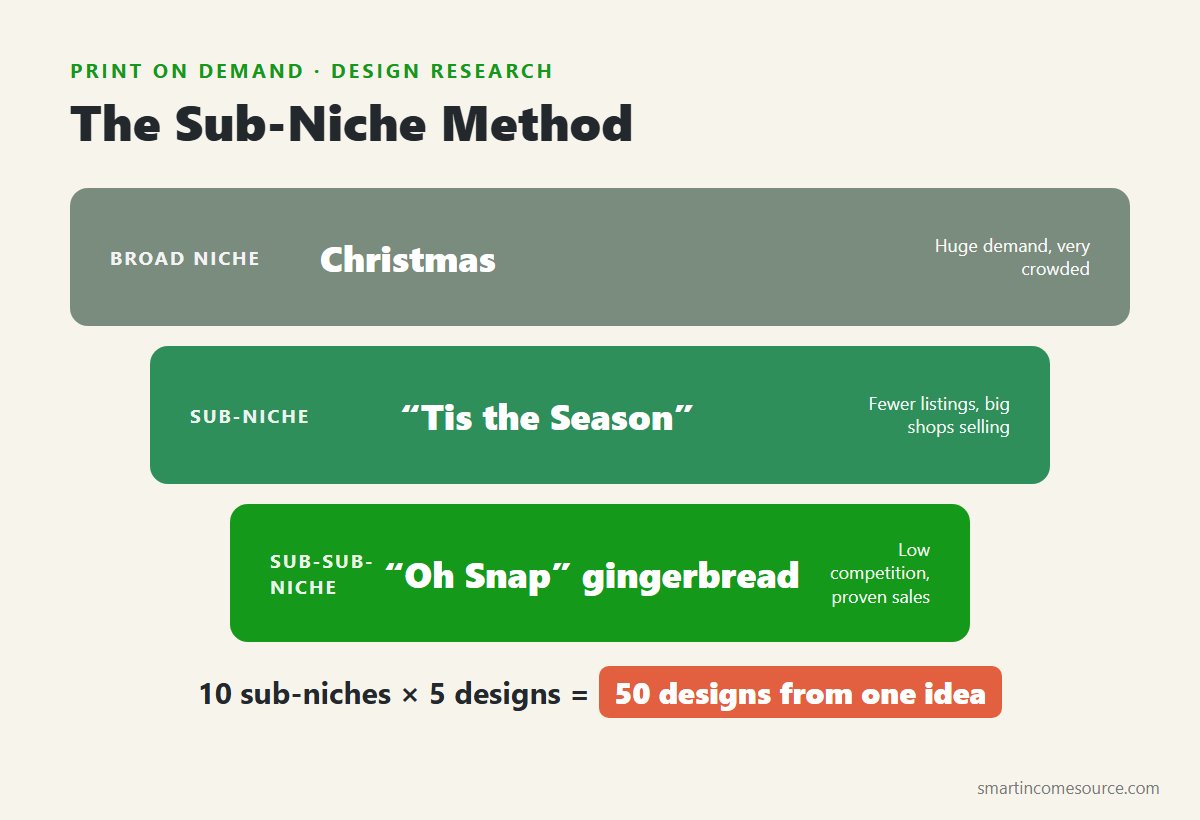
This is the heart of the system. Instead of competing on broad topics, drill down:
Broad niche → Sub-niche → Sub-sub-niche
Example: Christmas → “Tis the Season” → “Oh Snap” gingerbread
How to do it:
- Search a broad niche on Etsy (for example, “Christmas shirt”).
- Note the best-selling slogans and themes you see.
- Search each slogan on its own. Look for:
- Far fewer competing listings than the broad search
- New listings ranking on page one (Etsy is actively testing them)
- Several large shops selling the same phrase
- Turn each validated sub-niche into a batch of 5–10 designs.
10 sub-niches × 5 designs = 50 designs from one idea. Repeat for every holiday, profession and hobby and you’ll never run out of ideas.
Design-hacking tips:
- Study the fonts, colors, slogan structure and art style of best sellers, then create your own original version. Never copy.
- Use AI tools and Kittl to speed up design creation.
- Always check trademarks before using a phrase. A phrase sold by many big shops is more likely to be generic, but verify it yourself on the USPTO trademark search.
- Publish seasonal designs about a month early so they’re indexed before buyers start shopping.
Step 4: Rank in Etsy search
How Etsy’s algorithm works in plain English:
- Etsy shows almost every new listing to a few shoppers.
- If people click, favorite, add to cart or buy, Etsy keeps showing it.
- If they ignore it, Etsy stops promoting it.
Think of Etsy as a store owner deciding what goes in the front window: products that sell earn more space.
The “free traffic formula” is simple:
- Research first. Find a sub-niche with proven sales.
- Borrow proven keywords. Use titles and tags from best-selling listings in that sub-niche, rewritten in your own words.
- Publish more listings. Volume gives Etsy more chances to find your winners.
Also optimize: keyword-rich titles, all 13 tags, a helpful description, strong mockups, a listing video and organized shop sections.
Step 5: Use Etsy Ads profitably
Only advertise listings that already sell organically. Ads amplify winners; they rarely rescue losers.
The ROAS method
– You typically need a 2–3× return on ad spend (ROAS) just to break even.
– Judge a listing after 50–100 clicks. If it’s still under 2× ROAS, turn its ads off.
The cost-per-click method (more precise)
Work out the most you can pay per click:
Max cost per click = conversion rate × profit per sale
Example: a 3% conversion rate × $10 profit = $0.30 per click to break even. If your actual CPC is $0.10, 100 clicks cost $10 and bring about 3 sales ($30 profit), so you double your money. Scale that listing.
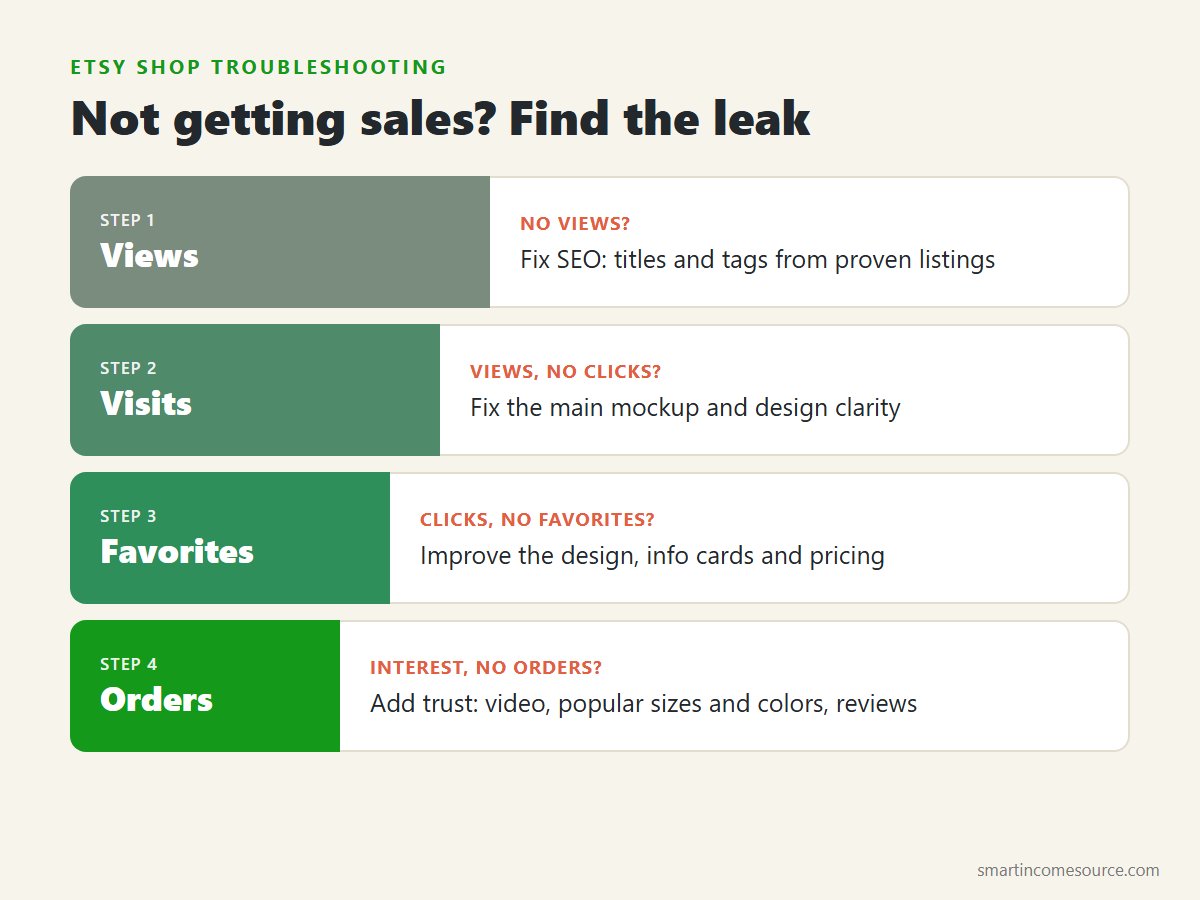
Not getting sales? Use this diagnostic funnel
Work through the funnel to find exactly what to fix:
| Problem | Likely cause | Fix |
|---|---|---|
| No views | Weak SEO | Improve titles and tags with proven keywords |
| Views, no clicks | Thumbnail problem | Better main mockup, clearer design |
| Clicks, no favorites or add-to-carts | Offer problem | Stronger design, info cards, fairer pricing |
| Interest, no orders | Trust problem | Add a video, popular colors and sizes, improve reviews |
When something sells: double down
Any listing that sells is a winner. Duplicate it with small changes (new mockup, colorway, video or slight design tweak) so you have several chances to sell a proven idea. Then move the winning style to other niches (a design that sells for nurses can be adapted for teachers or accountants).
How long does it take to start print on demand successfully?
Think in number of listings, not months.
- The course creator reports averaging roughly $1 profit per listing per month across about 15,000 listings over six years.
- His conservative estimate: 1,000 quality listings ≈ $1,000–$2,000 profit per month.
- Another benchmark from the course: 100 listings each selling 15 times a month at $7 profit ≈ $10,000 per month. You may need to publish several hundred to find those 100 winners.
Results vary a lot and aren’t guaranteed. They depend on design quality, research and consistency. See our earnings disclaimer.
Will this still work in 2027 and beyond?
Specific numbers like fees, shipping rates, ad costs and best-selling blanks will keep changing. The principles below are what make the method last:
- Buyer-intent marketplaces aren’t going away. People will keep searching Etsy (and similar marketplaces) for gifts, slogans and niche products. Selling where buyers already shop beats waiting for traffic you have to create.
- Data beats guessing. Whatever the year, start from listings that already sell, not from your own taste. Re-check the best-seller lists every season.
- Sub-niches stay open. Broad niches get more crowded every year, but new trends, sayings and micro-communities appear constantly. Drilling down is how newcomers keep finding room.
- AI makes design faster for everyone. That means more listings compete for attention, so research and originality become the edge, not speed. Use AI to save time, never to copy someone else’s work.
- Algorithms reward engagement. Etsy’s exact ranking factors will change, but clicks, favorites and sales will always matter. Strong mockups and clear designs stay essential.
- Volume plus consistency compounds. A catalog built steadily over months keeps working long after any single trend fades.
Future-proof habits:
- Re-check your profit math whenever Etsy or your supplier changes fees or prices.
- Review Printify’s best-seller list every quarter and adjust your product mix.
- Plan seasonal designs one to two months early.
- Keep an email list (for example with a free starter kit) so you’re never 100% dependent on one platform.
- Once you have proven winners, consider a second sales channel such as your own store.
FAQ
How much does it cost to start print on demand?
Very little. You can start print on demand with a free Printify plan and a few Etsy listing fees; paid tools are optional.
Is print on demand still worth starting in 2027?
Yes, if you focus on proven products, research sub-niches and publish consistently. Competition grows every year, so research and quality matter more than ever. Margins are thinner than with your own stock, so keep your pricing tight.
Do I need design skills to start?
No. Tools like Kittl and AI image generators make simple, slogan-based designs easy. Research matters more than artistic skill.
Why use Etsy instead of my own Shopify store?
Etsy brings built-in buyer traffic. Beginners can get sales without paying for ads, then move proven winners to their own store later.
What are the ongoing costs?
Very little. Etsy charges a small fee per listing (new shops often get free listing credits through referral links), and Printify has a free plan. Optional paid tools speed things up.
Is it legal to use popular slogans?
Only if they aren’t trademarked. Always check the USPTO database, and never use brand names, characters or copyrighted art.
Final thoughts on how to start print on demand
Print on demand isn’t passive on day one, but it becomes passive as your catalog grows. Pick evergreen products, price for at least $7 profit, mine sub-niches for designs, optimize for Etsy search, and double down on every winner.
Your next step: this is how to start print on demand the practical way: open your Etsy shop, connect Printify, and publish your first 10 listings this week. Then build from there, one consistent week at a time.
Last updated: November 2026. We review this guide regularly as platforms change.
Source: “How To Start Print On Demand from Scratch in 2026” by Alek / Six Figure Storefront on YouTube. This article is an independent summary and commentary.