
Most newbies step into online marketing believing that success comes from buying the next course, tool, or “proven system.”
When things don’t work, they assume they’re missing one more strategy or secret. So they keep buying… and buying… and buying.
And that’s where most newbies get stuck. The only thing that has changed is that their wallets have gotten lighter.
The problem usually isn’t a lack of motivation or effort. What beginners often lack are the right skills. Skills that help you create content, build products, make sales and so on.
Application of these skills will translate into sales and profits. This is the antidote to drowning in information overload and going nowhere.
In this article, you’ll be shown 7 core skills every new marketer needs to succeed online in 2026.
Unlike trendy tactics or short-lived hacks, these are practical, timeless skills that make everything else work better, and help you build momentum without overwhelm or guesswork.
It doesn’t matter if you’re selling infoproducts, running a Shopify store, publishing on KDP or posting videos on your YouTube channel – you’ll still need most of these skills. So let’s begin…
Skill #1: Learning How to Use AI as a Practical Tool
AI should never be used as a crutch for dull or lazy content. There’s a lot of hate towards AI… but in 2026, you must learn how to leverage it in your marketing.
It’s either that or get left behind.
Knowing how to use the right AI tools can free up a huge amount of time and mental energy.
Instead of staring at a blank screen and struggling to cook up ideas, you can now focus on letting AI do the thinking… while you do the refining.
For example, you can use AI to generate ideas, create content outlines, plan a content calendar, draft rough content, and even generate images.
From there, you edit and humanize the output so it sounds like a real person wrote it. That’s where your voice and judgment still matter. But you’ve sped up the entire process.
Contrary to what many beginners believe, AI isn’t complicated and it doesn’t require deep technical knowledge. You can get powerful results with just a few simple prompts. And ironically, you can even use AI to help you create better prompts.
Used correctly, AI will amplify your skills. You may wish to join Facebook groups (or follow marketers) where content dedicated to AI is shared.
Here are a few highly popular AI tools you may wish to get familiar with:
- ChatGPT: https://chatgpt.com
Used for writing content, brainstorming ideas, outlining articles, research, personal branding, and thinking through marketing strategies.
- Claude: https://claude.ai
Strong at long-form writing, reasoning, structuring copy, and refining ideas without sounding robotic.
- Codeium: https://codeium.com
Helps write, complete, and fix code across many languages, even if you’re not an experienced developer.
- Copy.ai: https://www.copy.ai
Built specifically for marketing copy like emails, ads, landing pages, and social media posts.
- Cursor: https://cursor.sh
An AI-powered code editor that lets you vibe-code websites, scripts, and tools using plain English instructions.
- Descript: https://www.descript.com
Allows you to edit podcasts and videos by editing text, making audio and video production much faster.
- ElevenLabs: https://elevenlabs.io
Creates realistic AI voices or voice clones for videos, podcasts, and voiceovers.
- Framer AI: https://www.framer.com/ai
Generates full websites and landing pages from simple prompts, combining design and code automatically.
- Luma AI: https://lumalabs.ai
Used to create 3D models and visual assets for demos, products, or creative content.
- Midjourney: https://www.midjourney.com
Creates high-quality AI images and illustrations for content, ads, thumbnails, and branding.
- Perplexity: https://www.perplexity.ai
Great for fast, accurate research without digging through endless search results.
- RecCloud: https://reccloud.com
Summarizes YouTube videos so you can extract key ideas quickly.
- Replit: https://replit.com
Lets you vibe-code websites, landing pages, and small internal tools with AI assistance.
- Runway: https://runwayml.com
Used for AI-powered video editing, effects, and advanced video tasks.
- Suno: https://suno.ai
Creates original music for videos, podcasts, and background audio.
- Syllaby: https://syllaby.io
Uses AI to generate videos and content ideas, mainly for social media marketing.
You don’t need to master all of them. Just have a rough idea of what each tool does and whether you’ll need it in your marketing.
For example, if you’re starting a faceless YouTube channel, you may wish to use ChatGPT to create the content, then use Syllaby to create the videos.
Once you understand how to use AI as a practical assistant, everything else in your marketing becomes easier.
Skill #2: Basic Tech Skills (So You Can Actually Launch Things)
A lot of newbie marketers avoid the tech like it’s a venomous snake.
They’ll spend weeks “planning” and “researching” – but won’t build a simple sales page because it feels intimidating.
Here’s the truth: If you want to succeed online in 2026, you need basic tech skills. Not advanced coding skills. Just the basics.
You should know how to build a clean sales page using tools like OptimizePress, Systeme.io, or any other page builder.
And yes, it needs to be mobile responsive, because most people will see your page on their phone while half-watching Netflix.
You should also understand how to use a marketplace if that’s part of your plan.
Gumroad, Whop, WarriorPlus, and so on. You don’t need to know them all. Just learn the one you’re actually going to use.
Most of these tools are designed to be beginner-friendly.
You don’t need a degree in rocket science to use them. All it takes is a willingness to click around, get familiar with the dashboard, and push through the learning curve.
If you get stuck, there are tutorials on YouTube and inside the tool’s knowledgebase. And if you still can’t find what you need, ask ChatGPT for step-by-step instructions.
Spend one hour a day learning it. Within a week or two, you’ll be using these tools like a pro.
It’s easier than you think. And once you get it, it stays with you.
Skill #3: Networking and Building Relationships
Online marketing isn’t a solo sport. No matter how good your product or content is, you won’t get very far doing everything alone.
Networking helps you find affiliates, collaborate with other vendors or authors, and get your offers in front of new audiences.
It also helps you build real relationships with people who are on the same path as you. No man is an island, and nothing in online business exists in isolation.
You don’t need to be a networking wizard. Just start simple by joining relevant Facebook groups and engaging in conversations. Reach out to peers for genuine collaborations or cross-promotions.
Strong relationships compound over time, just like everything else in online marketing.
Skill #4: Getting Consistent Traffic
You can have the best offer in the world, but without traffic, nothing happens.
That’s why traffic is a must-have skill for anyone who wants to succeed online. The key is to keep it simple.
Choose one organic traffic method and one paid traffic method, then go deep with both.
Pick platforms that align with your niche and business model, whether that’s content marketing, social media, SEO, or ads. Organic traffic rewards consistency, so showing up regularly matters more than being perfect.
Paid traffic can feel like a monumental endeavor at first, but when you approach it slowly and systematically, it becomes manageable. Learn the basics, test small, and improve over time.

Master traffic, and everything else in your business gets easier… and more profitable.
Skill #5: Copywriting That Converts (Not Wins Awards)
You don’t need to be a master copywriter to make sales online. As long as your copy is clear, relevant, and focused on one simple outcome, your sales page can convert.
With AI, copywriting is now well within reach of most newbies. You can ask ChatGPT for proven copywriting frameworks and use those as a starting point.
From there, it’s just a matter of filling in the blanks and making the copy sound like you. A short back-and-forth conversation is often enough to produce solid, professional-looking copy.
If you prefer a dedicated tool, something like Closers Copy can also get the job done.
Your goal here is not to impress anyone with clever wording. All you’re trying to do is help people decide. Once you can show that your product will help them get the transformation they’re looking for – you’ll start converting.
And AI is good enough to generate copy that does this.
Skill #6: List Building (Because Algorithms Are Not Your Friends)
This skill ties directly into your tech skills, whether you like it or not.
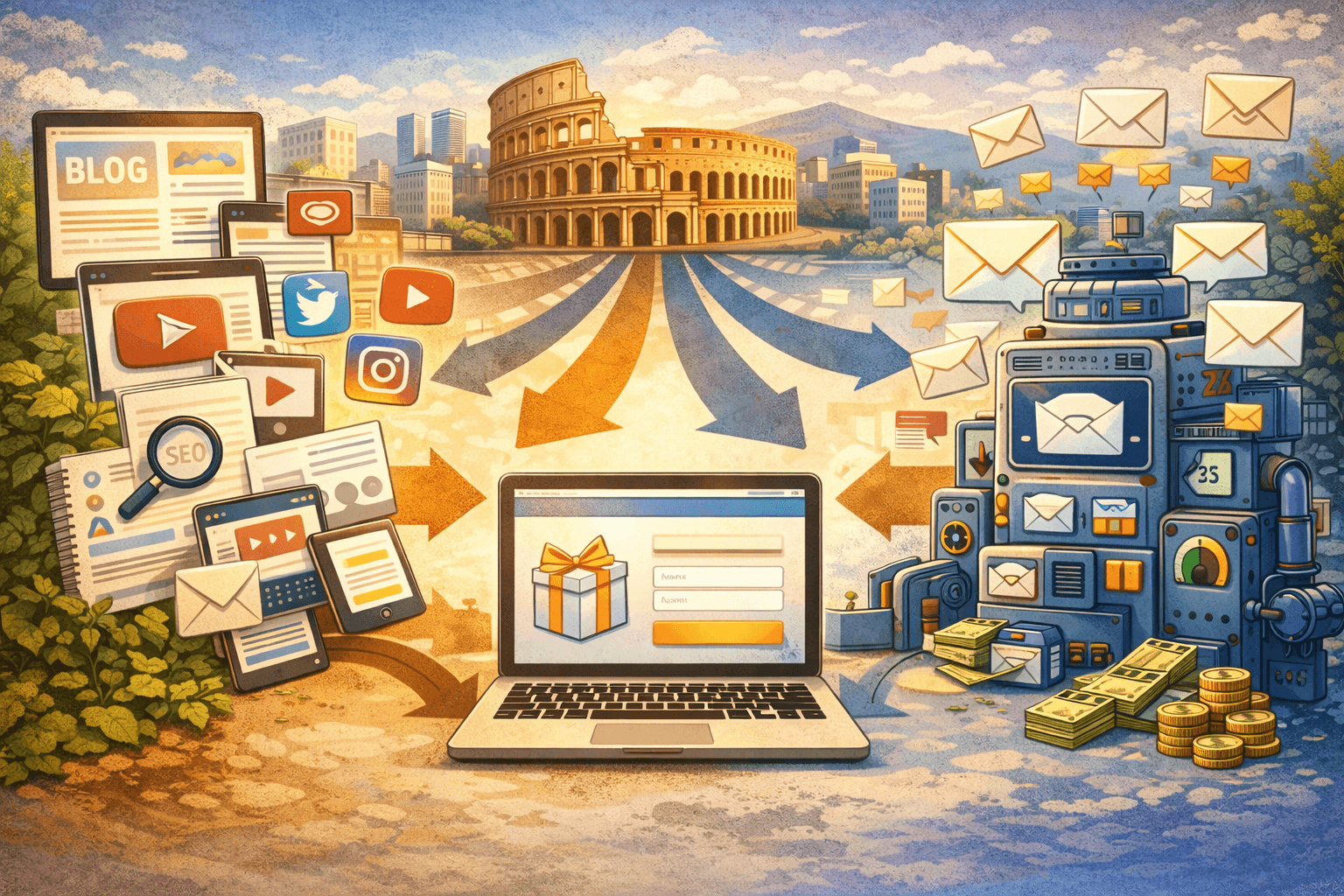
You need to know how to build a solid landing page and make sure your content points to it. Blog posts, videos, social content, comments.
All roads lead to Rome, and in this case, Rome is your opt-in page.
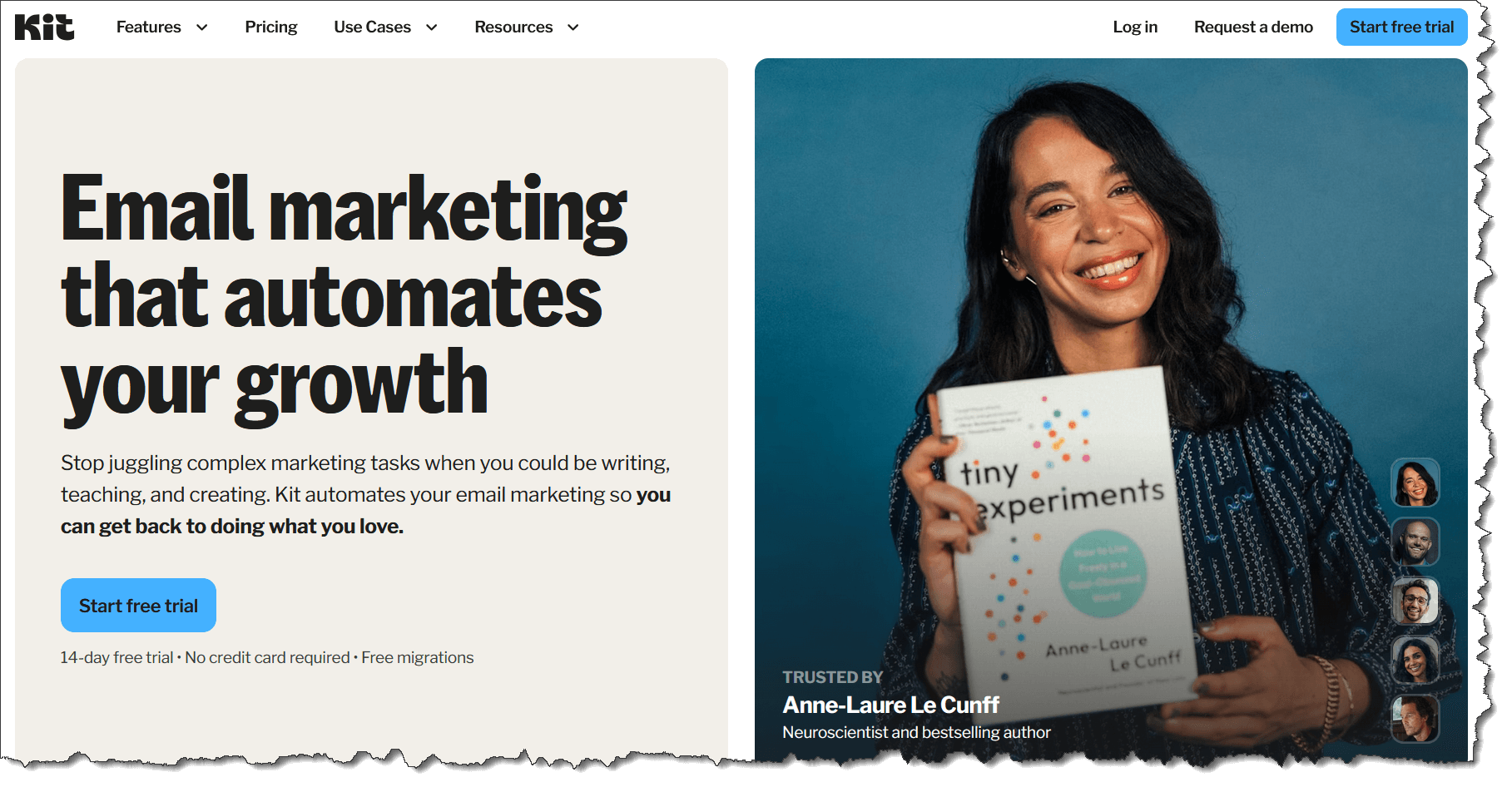
You’ll also need an autoresponder to collect and follow up with leads. That could be something like Kit, or the built-in email system inside an all-in-one platform like Systeme.io.
The tool matters less than knowing how to use it properly.
The basics are simple. Create a clear landing page. Offer a good bribe in exchange for the email address. Connect everything so it runs smoothly. Then send traffic to it.
Do this right and you’re no longer at the mercy of platforms or algorithms. You’re building an asset you actually own.
Skill #7: Email Marketing (Where the Real Money Is)
Building a list is only the first step. The real money is in your relationship with that list.
If you don’t know how to communicate with your subscribers, send useful emails, and stay top of mind, your list won’t do much for you.
Strong email marketing skills are what turn subscribers into readers, readers into buyers, and buyers into repeat customers.
AI can help here too.
You can use ChatGPT to draft emails, come up with ideas, or structure your messages. But you still need to tweak the output so it’s more useful, more valuable, and more entertaining.
People aren’t amused by polished marketing emails. What they want are emails that sound human.
If you can get this right, your list will like you, trust you and you’ll create sales with most of your emails.
Final Thoughts
Online marketing in 2026 isn’t about knowing everything or owning every tool under the sun. It’s all about having the right skills and actually using them.
You don’t need to master all seven at once. Pick one, work on it, then move on to the next. Progress beats perfection every single time.
If you focus on building these skills instead of chasing shortcuts, things will start to click.
Content creation will get easier. Tech will feel less scary and you’ll become more competent at it. Traffic will become predictable and sales will stop feeling like a lucky accident.
So keep it all simple and consistent. Your skills will compound… and with time, so will your profits.